September 1, 2026 | Press Release
Myllia Biotechnology, a leader in high-content CRISPR screening in primary human cell models, today highlighted the landmark publication of the State virtual cell model by Arc Institute in Cell (https://www.cell.com/cell/fulltext/S0092-8674(26)00921-9) as a defining moment for the field of AI-driven cell biology – and reaffirmed its commitment to serving as the industry’s premier source of Perturb-Seq datasets generated in disease-relevant, primary human cells.
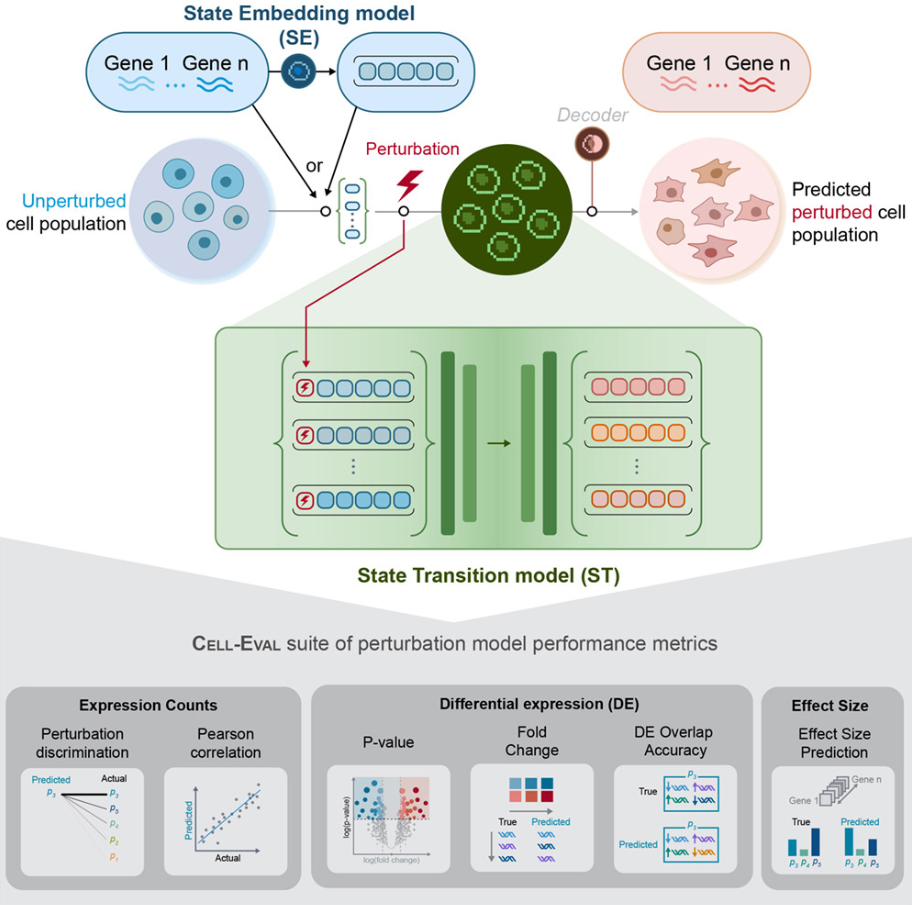
The State model, introduced by Arc Institute, is a machine learning architecture that predicts how stem cells, cancer cells, and immune cells respond to drugs, cytokines, or genetic perturbations. State was trained on observational data from nearly 170 million cells and perturbational data from more than 100 million cells across 70 cell lines, and consists of two interlocking modules – the State Embedding (SE) model and the State Transition (ST) model – that together predict transcriptional shifts following perturbation with unprecedented accuracy. In benchmarks, State demonstrated a 50% improvement in distinguishing perturbation effects and twice the accuracy in identifying true differentially expressed genes compared to existing state-of-the-art methods.
The publication underscores a critical bottleneck now facing the entire single-cell foundation model (scFM) community: while observational scRNA-seq data is abundant, large-scale, high-quality perturbation data in physiologically relevant primary human cells remains scarce – and it is precisely this type of data that is required to teach AI models the causal biology of human disease.
Myllia: Built for the Single-Cell Perturbomics Era
Myllia’s CROP-Seq (Perturb-Seq) platform combines pooled CRISPR perturbation with single-cell RNA sequencing in context-specific, primary human cell models to deliver deeply mechanistic, causal datasets at scale. Unlike screens performed in immortalized cancer lines, Myllia’s datasets capture the true biology of the human cells that drugs must ultimately act upon.
“The State publication is a watershed moment. It shows, in the most rigorous way yet, that virtual cell models can learn causal biology – but only if they are fed with high-quality, large-scale perturbation data.”
said Adam Krejci, VP of Computational Biology at Myllia Biotechnology.
“For years, we have been building the industrial-scale Perturb-seq engine in primary human cell models that this moment demands.”
added Dr. Tilmann Buerckstuemmer, Co-Founder and CSO of Myllia Biotechnology.
Single-Cell Perturbation Data for the AI/ML and scFM Community
With State now setting a new bar for predicting cellular perturbation phenotypes, Myllia invites AI/ML teams, foundation model developers, and biopharma partners working on virtual cells, perturbation prediction, or in silico target discovery to engage on single-cell perturbomics collaborations. Myllia’s technology platform at a glance:
- Custom Perturb-seq campaigns in disease-relevant primary human cells, including therapeutic areas such as immunology and inflammation, kidney biology, oncology and metabolic disease;
- Genome-scale and focused screens producing causal, mechanism-resolved single-cell readouts suitable for scFM training data and evaluation benchmarks;
- Off-the-shelf CROP-Seq perturbation datasets available for licensing, generated in primary human cell models;
- Bespoke library design and bioinformatic support tailored to model training and benchmarking needs – an end-to-end offering enabling advanced functional genomics.